Kampala’s skyline is expanding at breakneck speed. From the rolling hills of Kulambiro and Kiwatule to the commercial corridors of Nakawa and Central Division, multi-story developments are reshaping Uganda’s capital.
Yet behind the fresh coats of paint and glossy architectural renders lies a sobering reality. Over the past decade, investigations by the National Building Review Board (NBRB) and the Kampala Capital City Authority (KCCA) have flagged thousands of structures for non-compliance, with catastrophic collapses claiming lives, destroying capital, and leaving property buyers in legal and financial ruin.
For property investors—both locally in Uganda and across the diaspora—the question is no longer just “What is the rental yield?” It is “Will this building stand the test of time?”
Understanding why buildings fail in Kampala is the first step toward safeguarding your hard-earned capital. More importantly, understanding how international engineering benchmarks and architect-led construction models solve these failures is redefining what quality housing looks like in East Africa.
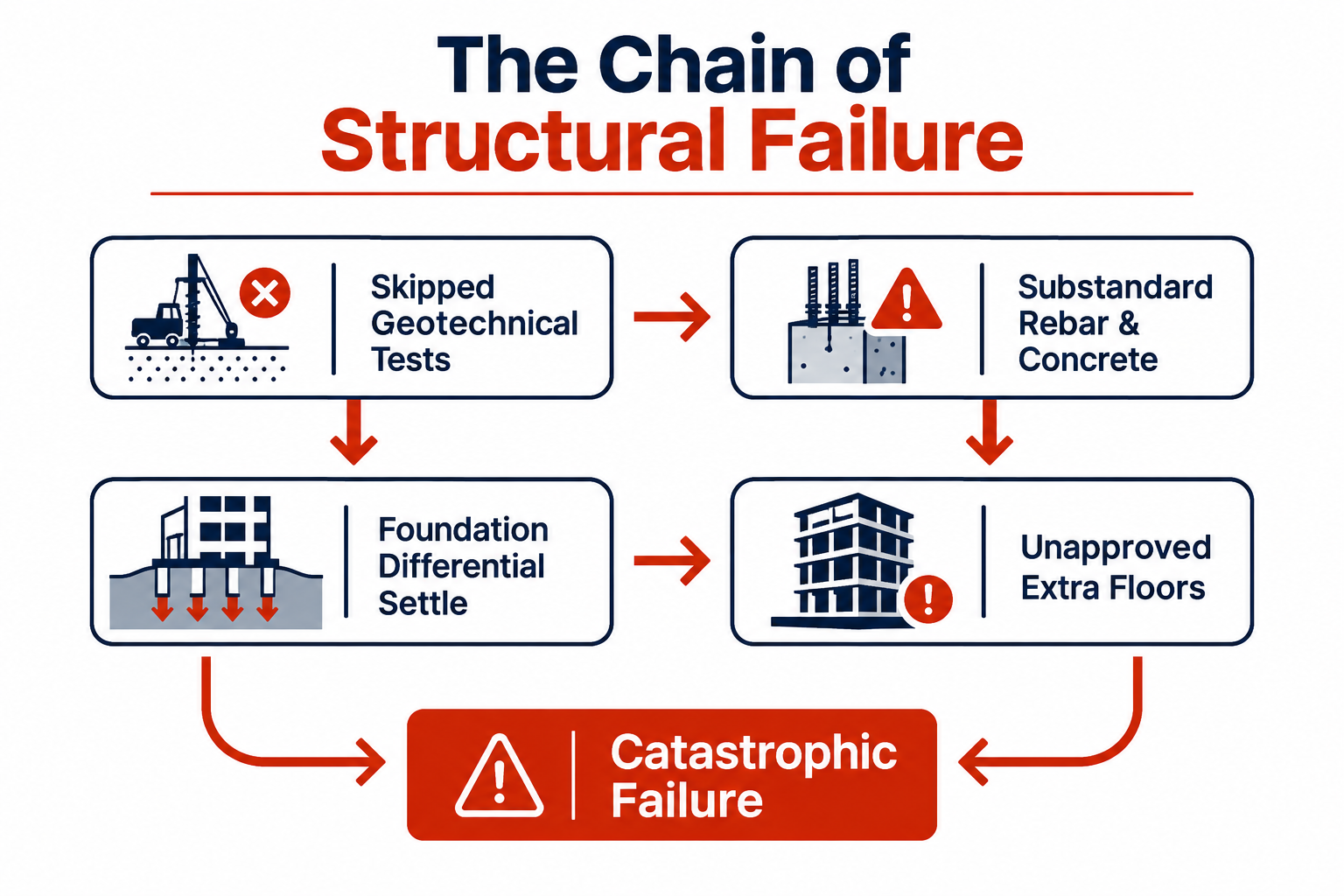
The Four Root Causes of Building Failures in Kampala
Building collapses and structural defects rarely happen by accident; they are the predictable outcome of compromised engineering and unregulated shortcuts.
1. Skipping Geotechnical Soil Investigations
Kampala’s topography features steep hills, valley bottoms, and heavy red clay (laterite) soils with significant shrink-swell behavior during alternating wet and dry seasons. Many informal contractors bypass laboratory soil testing, failing to assess liquid limits, plastic limits, or load-bearing capacities. When a heavy concrete structure is placed on an unreinforced, shallow foundation without proper piling or compaction, differential settlement begins, producing diagonal shear cracks and foundation destabilization.
2. Substandard Materials and Counterfeit Rebar
In a bid to maximize short-term margins, developers frequently purchase uncertified steel rebar with low tensile strength or mix concrete using contaminated sand and improper water-cement ratios. Forensic audits on distressed buildings in Kampala regularly document concrete compressive strengths dropping as low as 5 to 10 N/mm²—well below the 25 to 30 N/mm² minimum required for multi-story load-bearing frames.
3. “Contractor-Led” Execution Without Architectural Oversight
In Uganda, a common practice is to hire an architect merely to produce drawings for council submission, after which an independent building contractor takes over site execution unsupervised. Without structural engineers and architects conducting continuous stage inspections, crucial structural details—such as beam-column joint stirrups, rebar lap lengths, and concrete curing protocols—are routinely mismanaged.
4. Unapproved Load Expansions and Poor Drainage
Many speculative builders obtain permits for a three-story structure, only to add a fourth or fifth floor mid-construction when cash flow demands more units. Compounding this, inadequate stormwater management during Kampala’s torrential downpours allows runoff to pool around building bases, saturating the subsoil and triggering foundation scour.
The Structural Divide: Traditional Contracting vs. Architect-Led Engineering
The traditional construction model separates design from execution, incentivizing contractors to cut invisible structural corners. The modern alternative—integrated, architect-led design paired with international green building standards—unifies accountability under one roof.
| Evaluation Metric | Traditional Kampala Contracting | Architect-Led / LEED Standard (Aesthetic Developers) |
| Site Due Diligence | Surface-level inspection; generic foundation assumptions | Rigorous geotechnical soil testing and tailored structural footing |
| Material Quality | Unverified local sourcing; batch-to-batch inconsistency | Standardized, laboratory-tested high-grade concrete & certified steel rebar |
| Site Oversight | Periodic site visits; non-technical foreman execution | Continuous, architect-led engineering supervision across all phases |
| Climate Adaptation | Reliance on active cooling (AC) and generic exterior drainage | Passive ventilation, solar orientation, rainwater harvesting, & sustainable drainage |
| Legal & Title Security | Frequent unpermitted structural modifications | Fully permitted plans, condominium titling, and 100% verified compliance |
How Aesthetic Developers Is Engineering Long-Term Resilience
At Aesthetic Developers, structural durability and architectural elegance are treated as two sides of the same coin. By adopting an architect-led build methodology and integrating LEED (Leadership in Energy and Environmental Design) principles, modern projects like Habitat 854 in Kulambiro are setting a new standard for Uganda’s urban core.
1. Architect-Led Project Delivery
Rather than handing designs off to third-party general contractors who optimize for speed and cost over structural integrity, Aesthetic Developers manages the lifecycle of the build. Architects and structural engineers remain on site from excavation to the final pour of concrete. Every beam, column, and joint is inspected against strict engineering tolerances before concrete is cast.
2. Engineering for Kampala’s Climate
Building in tropical climates requires structures that breathe and shed water efficiently:
- Passive Ventilation & Daylighting: Units at Habitat 854 feature dual-aspect window orientations and central courtyards that create natural cross-ventilation, eliminating trapped heat and reducing humidity-induced mold.
- Integrated Stormwater & Rainwater Harvesting: Dedicated rainwater containment and on-site drainage networks ensure that extreme tropical rains are diverted away from foundations and repurposed for landscaping and maintenance.
- Renewable Energy Integration: Rooftop solar installations and energy-efficient lighting grids reduce the building’s operational load on the national grid while insulating residents from power fluctuations.
3. Condominium Transparency and Uncompromised Due Diligence
True sustainability includes legal sustainability. For diaspora and local buyers, investment security requires clean land titles and verified statutory permissions. Every unit is backed by verifiable KCCA and NBRB development approvals, clear condominium ownership structures, and milestone-tracked construction updates.
5 Questions Every Buyer Must Ask Before Investing in a Kampala Property
Before wiring a deposit on an off-plan or newly built property in Uganda, insist on concrete answers to these essential questions:
- “Can you share the geotechnical soil investigation report for this specific site?”If a developer cannot provide a certified soil analysis from a recognized testing laboratory, foundation integrity is unverified.
- “Who is supervising site works—the designing architect/engineer or a third-party subcontractor?”Architect-led developments maintain design fidelity; unmonitored contractor projects carry high variance in material execution.
- “What concrete grade and reinforcement specifications are documented in the structural calculations?”Request documentation of continuous non-destructive testing (NDT) or cube test results for load-bearing columns.
- “What stormwater and wastewater mitigation systems are integrated into the design?”Look for biodigesters, rainwater harvesting, and engineered retaining walls that safeguard the structure against seasonal erosion.
- “Is the project approved for individual Condominium Titles?”Ensure that your purchase provides clean, unencumbered freehold or long-term leasehold condominium documentation.
A home or real estate asset should represent security, wealth preservation, and pride of ownership—never structural anxiety. By choosing developments engineered to global benchmarks, built under strict architectural oversight, and adapted to Uganda’s climate, investors can confidently secure assets that appreciate in value for decades to come.
To explore the critical regulatory and structural oversights uncovered during building investigations in Uganda, watch this NBRB Building Collapse Investigation Report.
This report from local news coverage details the direct findings of Uganda’s National Building Review Board regarding unpermitted work and engineering compromises on Kampala building sites.